By Stockpile Reports®, powered by EveryPoint®
The AI conversation is loud right now, and a lot of it is hard to connect to the daily work of producing, distributing, and supplying bulk materials, or running a construction services yard. This guide keeps it practical. It explains the terms you will hear in what people call the agentic supply chain, what this new environment means for your operation, the benefits, and how to get started connecting your stockpile data to the AI assistant your team already uses.
We built the Stockpile Reports MCP for a specific reason. A front-end loader scoops material and moves it exactly where it needs to go. Stockpile Reports does the same with your numbers, and the MCP loads them into the newest place they are needed, the AI assistant your team already uses. The hardest part of this business, whether you produce and distribute aggregate or manage supply across construction sites, has always been making decisions on numbers you can trust. Physical AI is not a someday technology. If your team already uses Stockpile Reports, you are using physical AI, and those measurements are ready to put to work.
Start with the basics: what Physical AI is
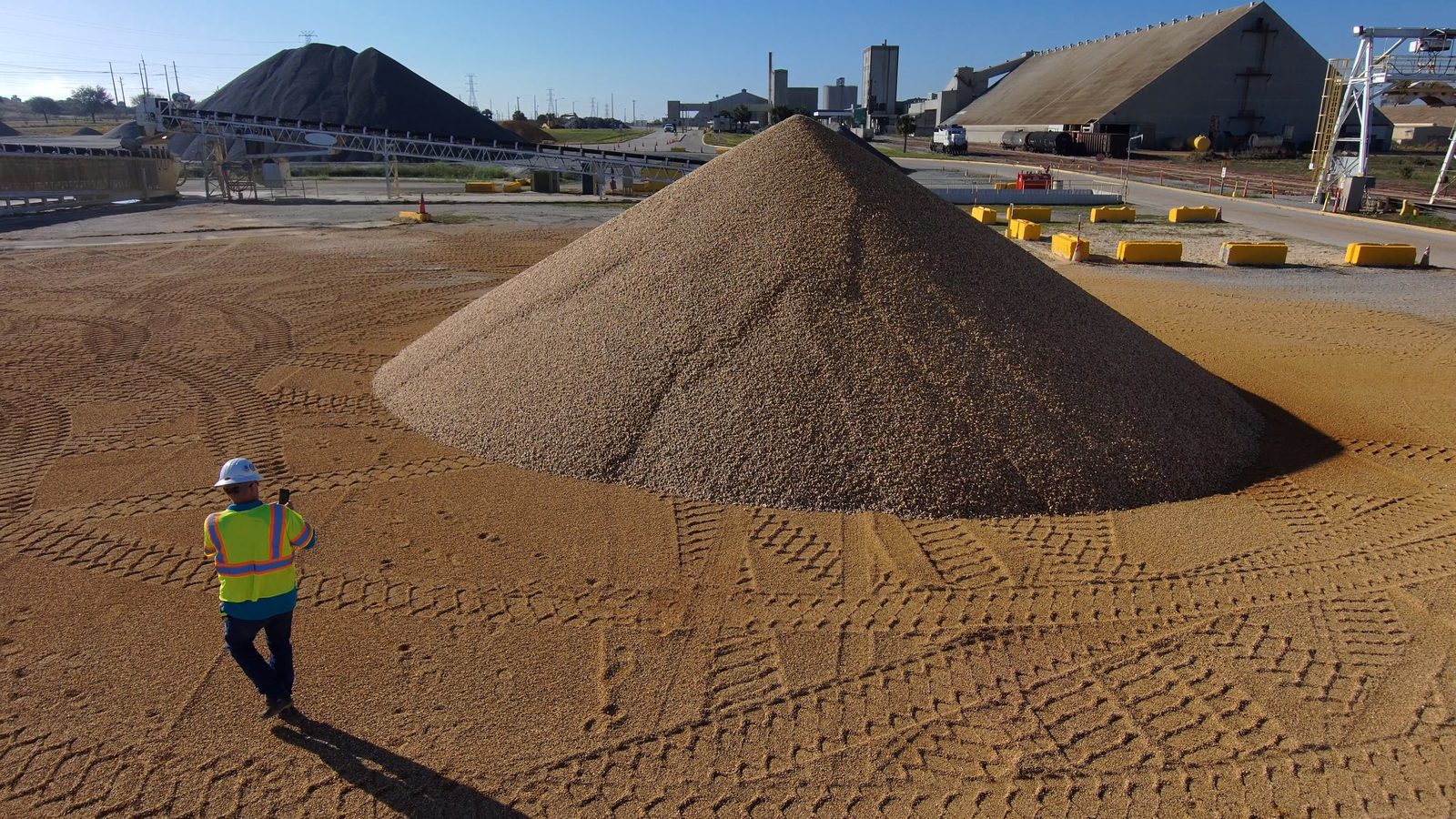
Physical AI is not the AI in the headlines. The chatbots people talk about are generative; they produce text from a prompt. Physical AI is predictive. It uses computer vision to see and measure the physical world from ordinary images, turning what a camera captures into accurate, actionable data. In bulk materials, that means turning imagery from a phone, drone, or installed camera into volume and tonnage, with coverage confidence. It is not guessing at the physical world. It is measuring it.
The terms, in plain language
Here are the words you will hear, and what each one means for your operation.
- Physical AI. AI that sees and measures the real world with computer vision, rather than generating text or images. It is predictive, not generative.
- Computer vision. The technology that reads an image and turns it into data.
- Ground truth. The real, on-the-ground fact. In your business the pile is the ground truth, and everything else is a report about it.
- A measurement you can stand behind. A volume and tonnage figure with the method and documentation behind it, not an estimate or a walked-off guess.
- Coverage confidence, high, medium or low, comes with every measurement Stockpile Reports computes from imagery: a surface score, and a toe score wherever the pile has an open base. A walking-wheel figure or a visual estimate you enter yourself carries none, because we did not compute it.
- Authoring layer. The point where reality first becomes data you can act on. Own it, and everything downstream inherits it.
- Edge. Short for edge computing: with SR Measure® the work happens on the device, in the field, on your iPhone, with no dependency on a distant data center. The measurement is computed where the material sits.
- AI assistant. The tools your team is starting to use in plain language, such as Claude, ChatGPT, Gemini, and Microsoft Copilot.
- MCP. The Model Context Protocol, an open standard that lets an AI assistant connect securely to outside data and tools. The Stockpile Reports MCP is the connection point that lets your assistant read your own stockpile data.
- Agent. AI that can take a step on its own, rather than only answering a question. For example, an agent could check the tonnage of #57 stone each morning and flag any yard that has dropped below its reorder point.
- Agentic supply chain. The near-term shift where your systems and AI assistants can ask your data a question and act on the answer. It only works when the data underneath is trustworthy.
- Active pile. A pile you are managing and measuring over time, so its on-hand inventory stays current as it grows and draws down.
Why it matters for your operation
- Decisions on measured facts, not stale data.
- Load once, count everywhere. When inventory, demand planning, and dispatch run on the same figure, everyone from production to distribution to the sales desk works from a single source of truth.
- Safety. Measuring from imagery keeps crews off the pile and away from working loaders, since no one has to climb up or walk it to get a count.
- Fewer disputes. When both sides see the same measurement, the argument mostly goes away.
- Answers in plain language. Ask your own data a question and get a number you can defend, in seconds.
- No big IT spend. The tool is already in your crew’s pocket, on the iPhone they carry.
Getting started: connect your data to your AI assistant
The Stockpile Reports MCP lets your AI assistant read your own measurements. It is only as good as the data underneath it, so a little setup goes a long way.
- Keep your piles active and measured. Measure regularly so your on-hand inventory stays current. Frequent measurement means no stale data.
- Structure your data. Set up products and sites and name them consistently, so a question like “#57 stone at Yard A” has a clean answer.
- Turn on the Stockpile Reports MCP. It is available to Business customers. Get started at stockpilereports.ai, or opt in from your Stockpile Reports account.
- Connect the assistant your team uses. The MCP works with Claude, ChatGPT, Gemini, and Copilot.
- Ask specific questions. For example: “What is the total tonnage of #57 stone across all yards as of yesterday?” or “At this week’s sell-through, when does Yard A hit its reorder point?”
Common questions
Is this the same as ChatGPT? No. Physical AI measures the physical world; the AI assistant is the interface you ask through. Stockpile Reports is the tool the assistant calls for pile data.
Do I need to be technical to use it? No. If your team already measures with Stockpile Reports, turning on the MCP is a setting, not a project.
How current is the answer I get? As current as your last measurement. That is why keeping your piles active and measured matters: the more often you measure, the closer your assistant is to today’s reality.
The bottom line
You already hold the ground truth for your business. The Stockpile Reports MCP loads your measurement of it into the AI assistant your team is starting to use, so decisions get made on facts instead of stale data. It is a loader in both senses: the machine on the pile, and the tool that moves your numbers everywhere they are needed. Start with the pile.
Every Pile, Any Time®
Stockpile Reports®, powered by EveryPoint®, digitizes bulk material inventory, turning imagery from a phone, drone, or installed camera into volume and tonnage. The Stockpile Reports MCP makes that data callable by AI assistants. Learn more at stockpilereports.com and stockpilereports.ai.