When Procore agreed to acquire DroneDeploy for approximately $845 million in cash, the headlines called it a construction software giant buying a drone company. That misses the point. Procore isn’t buying drones. It’s buying the layer where jobsite data is created, before anyone opens software to write it down.
That distinction matters well beyond construction. It applies just as directly to bulk materials.
What Procore is actually paying for
When AI can write code, software features stop being an advantage. Anyone can rebuild a workflow. Read the deal that way and two things Procore is buying stand out:
Authoring workflow
Own the authoring layer
Capture data the moment it’s created, not after it’s keyed into another tool.
Construction
Drones, robots, and cameras turn a changing site into data.
Workflow substitution
Own the outcome
The answer is generated and acted on, no tool opened.
Construction
An agent files the record. No one opens the app.
DroneDeploy brings Procore the authoring layer: its reality capture spans drones, ground robots, and fixed, mobile, and wearable cameras across more than 3 million jobsites in over 180 countries. That is where jobsite reality first becomes data. The hardware isn’t the prize. The data is.
Procore sits on two of the most valuable datasets in construction: its own nearly 400 million photos, more than 126 million drawings, and more than 10 million RFIs, submittals, and inspections logged in a single year, plus DroneDeploy’s roughly 20 trillion square feet of visual data. That dataset is the real asset. In its announcement, Procore describes evolving from the system of collaboration and record to the system of intelligence for construction: a platform that sees, understands, and acts on the jobsite. You can’t build that without owning the authoring layer. So Procore is buying it.
Same lesson for bulk materials
Procore’s world is the construction jobsite: RFIs, safety flags, daily logs, progress tracking, and the coordination of robots and equipment. Its authoring layer sees a whole changing site and turns thousands of construction events into construction workflows.
Construction is among the least digitized sectors in the world. McKinsey Global Institute’s 2017 industry digitization index put it second to last in the United States and last in Europe. Bulk materials sit upstream of that jobsite, and they’re still measured with manual tools: tape, walked-off estimates, month-end guesses. And the questions are different.
- How many tons are in that pile, today?
- Did we ship what the ticket says we shipped?
- Is month-end inventory real, or an estimate we’ll write off?
- Is production tracking to plan across sites we can’t all stand in front of?
You don’t answer these questions with a construction management platform. You answer with a measurement: a time-stamped volume and tonnage for a specific pile, with the documentation to back it up.
The same two advantages map onto bulk materials:
Authoring workflow
Own the authoring layer
Capture data the moment it’s created, not after it’s keyed into another tool.
Construction
Drones, robots, and cameras turn a changing site into data.
Bulk materials
Imagery from a phone, drone, or installed camera becomes volume and tonnage.
Workflow substitution
Own the outcome
The answer is generated and acted on, no tool opened.
Construction
An agent files the record. No one opens the app.
Bulk materials
An AI assistant returns the tonnage, with a coverage confidence score.
The authoring layer for bulk materials already exists
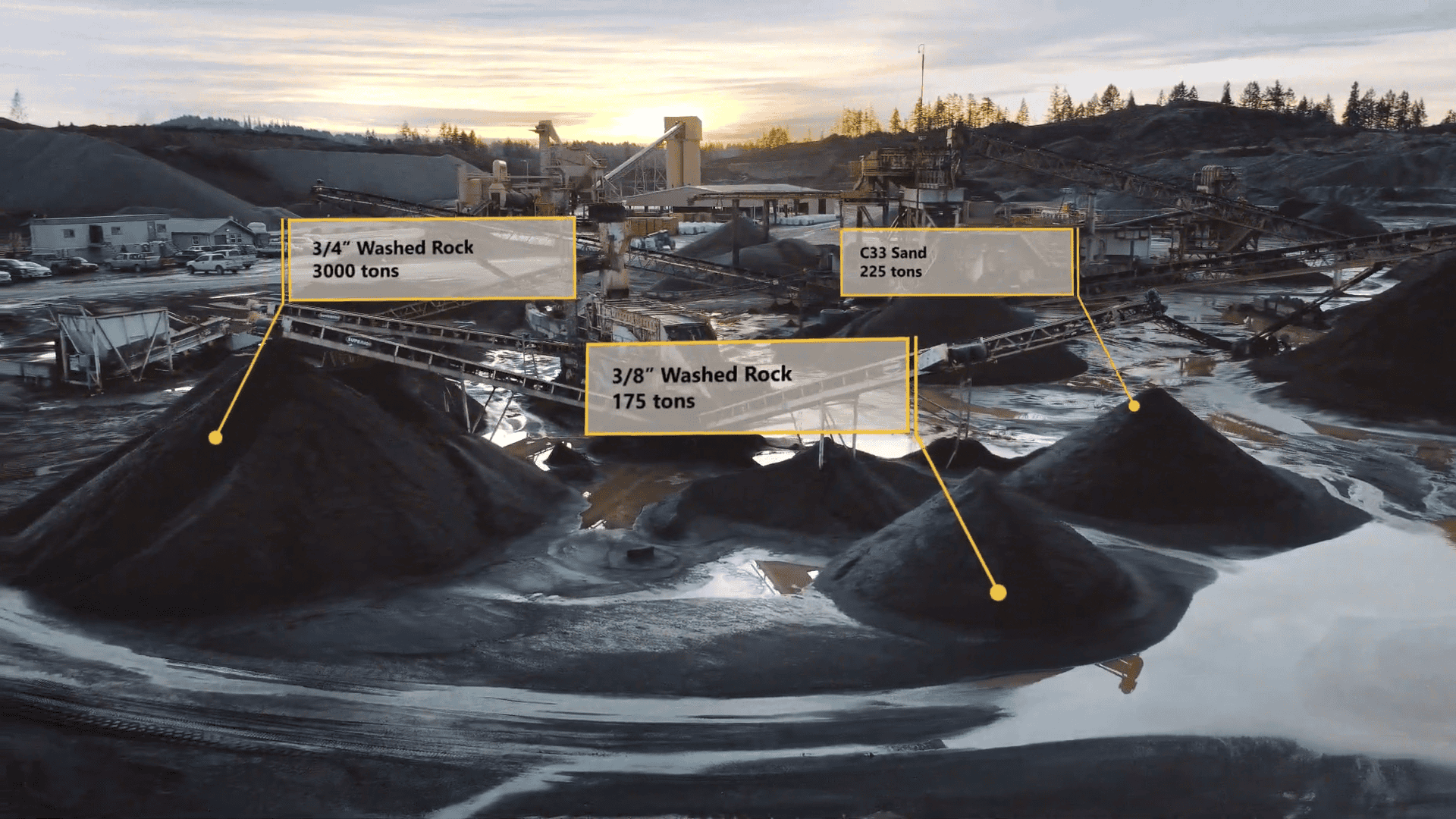
That’s what Stockpile Reports® is. Built on more than a decade of computer vision and machine learning, it is Predictive Physical AI that turns imagery from a phone, drone, or installed camera into an independent, verified report: accurate, defensible volume and tonnage, with coverage confidence. On a phone, the measurement is created on the device at the moment of capture, not re-keyed later into an ERP. That’s the authoring layer, and it’s live today, with hundreds of thousands of distinct stockpiles and more than 14 billion tons of material measured since 2012.
Underneath it is EveryPoint®, the Physical AI company training computer vision to see and measure the real world since 2011, on-device and at the edge. This is predictive AI, not generative: it perceives what a camera sees and turns it into accurate, actionable data. EveryPoint builds the Physical AI, Stockpile Reports turns it into an independent, verified report, and its MCP brings that report into your AI assistant. If the real prize in the Procore deal is the data, bulk materials has an advantage customers can build on: a data repository built since 2012 and 14 granted patents. It’s the same approach Procore is paying $845 million to secure.
“Procore is paying $845 million to own the moment jobsite reality becomes data. In bulk materials, that moment is a pile becoming an independent, verified report, and we’ve owned it since 2012. Every Pile, Any Time®, with a coverage confidence score.”
David Boardman, Founder and CEO, EveryPoint
Why a single source of truth wins
The authoring layer wins because everyone downstream inherits it. When an independent, verified report is shared across the supply chain, the vendor, supplier, and customer all work from the same number. Delivery disputes stop being arguments about whose number is right, because both sides are looking at the same report. The number that starts the workflow is the number everyone trusts.
That’s the bulk-materials version of what Procore is building: the independent, verified report triggers what happens next. Value is moving from standalone measurement to decision automation, and the decisions run on the report.
Now your AI assistant can ask
The direction Procore describes is a jobsite where perception is continuous and workflows fire automatically, with people overseeing. Bulk materials is heading the same way, through the same door: the AI assistant.
The Stockpile Reports MCP is live, a connection your AI assistant can call directly. Stockpile Reports isn’t the agent; it’s the tool the agent calls, the measurement it stands on. You can ask about your stockpiles from Claude, ChatGPT, Gemini, or Microsoft Copilot and get answers grounded in your own measurements. You don’t open a tool to find the tonnage. The agent asks the authoring layer and acts on a number that carries a coverage confidence score. An AI agent is only as good as the numbers it runs on, and these are numbers it can defend. Trusted data, AI, and the workflow it triggers: Stockpile Reports is all three.
The bottom line
The DroneDeploy deal is a preview of where every physical industry is going. The winners will own the authoring layer, the moment physical reality becomes trusted data.
For the construction jobsite, Procore is paying $845 million to secure it. For bulk materials, that layer already exists, and it’s already in your AI assistant. It’s called Stockpile Reports.
Every Pile, Any Time®