

A frequent question we get about SR Measure is: “Does your app use the iPhone’s LiDAR sensor?”
It’s a fair assumption. When Apple introduced LiDAR on the iPhone 12 Pro, it was promoted as the future of 3D scanning. But after putting it to the test in real quarry conditions, we found that iPhone LiDAR simply isn’t built for measuring stockpiles.
Instead, SR Measure is built on photogrammetry. An image-based method that delivers accurate, reliable results from any iPhone or Android device. And we’ve got the side-by-side tests to prove it.
Watch: iPhone LiDAR vs. SR Measure in the Field
Putting iPhone LiDAR to the Test
In our hands-on video, we tested two piles:
- A smaller sized pile about 1,000 tons and 14 feet tall.
- A much larger 6,000-ton pile at the same height but with a broader footprint.
We scanned each pile twice: once with iPhone LiDAR, and once with SR Measure’s image-based method.
On paper, LiDAR seemed promising. But in practice, two big issues appeared right away.
Range and Coverage
On the smaller pile, the LiDAR couldn’t capture the top edge from ground level. The laser simply didn’t reach far enough. The only way to cover it was to walk on the pile itself.
The larger pile exposed this problem even more clearly. After more than 10+ minutes walking the perimeter and on the pile, the scan still left gaps along the top edge of the pile surface. With an effective range of only 10-15 feet, iPhone LiDAR was never designed to capture stockpiles that are 14+ feet tall. The result? Incomplete stockpile measurements that underestimate volume.
Accuracy
The second issue was low accuracy due to measurement drift. As we walked around, the pile surface scanned by the LiDAR slowly shifted out of alignment. At first the errors were subtle, but by the end, the model of the 6,000-ton pile was skewed and the volume was unreliable.
It’s a bit like following a compass that’s just a few degrees off. At first you hardly notice, but the farther you travel, the more off course you end up. In the same way, the longer the LiDAR scan, the more the pile’s shape drifts away from reality.
For something as important as inventory counts, even small errors add up to big problems.
Watch: Behind the Tech of SR Measure
In this Q&A, our Chief Scientist Jared Heinly explains how LiDAR and photogrammetry actually work, why phone-based LiDAR struggles with stockpiles, and why SR Measure is built on a proven photo-based method.
Why SR Measure’s Approach Wins
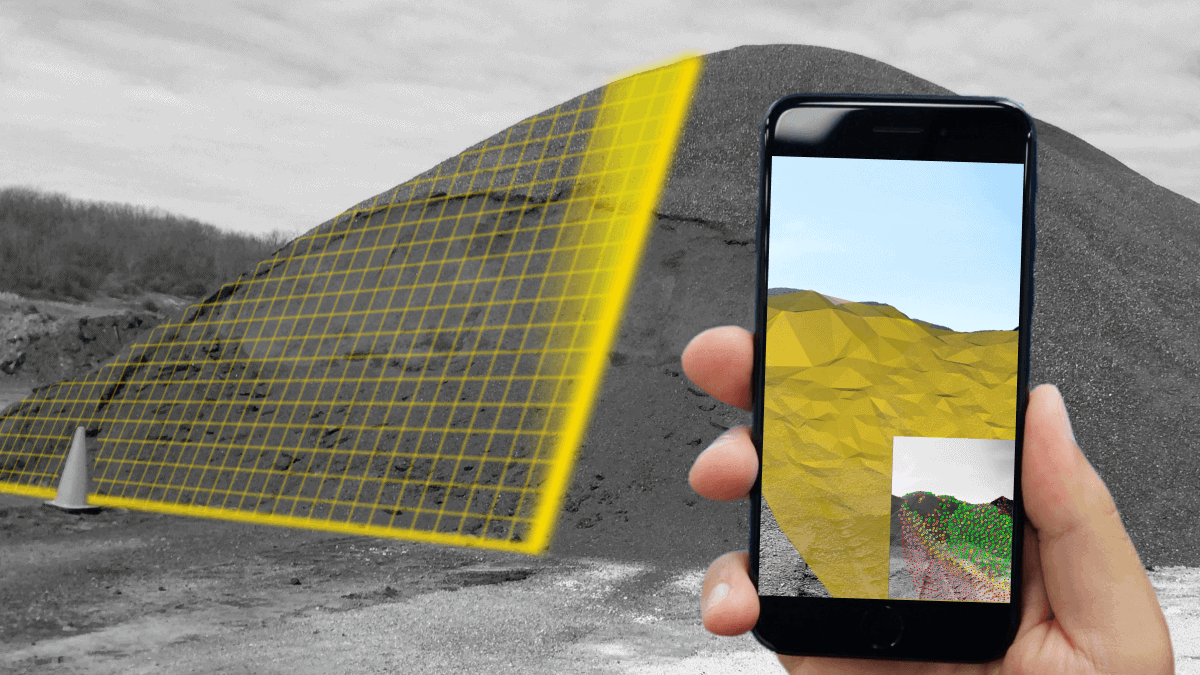
SR Measure takes a different approach. Instead of firing out lasers, it uses your phone’s camera to capture overlapping photos as you walk around a pile. Our software then reconstructs those photos into a complete, detailed 3D model using a time-tested method called photogrammetry.
This method solves both problems we saw with LiDAR:
- Full coverage: The entire pile is captured without climbing on the pile. If you can see the pile material on your screen, the app will measure it.
- Reliable accuracy: No drift, no missing tops, no skewed shapes.
When we compared the results, the difference was striking. The photogrammetry models were complete and true to the pile. The LiDAR models, by contrast, looked patchy and short, missing significant amounts of material.
Built for Any Jobsite, Any Phone
There’s another advantage to SR Measure’s method: it works across devices.
LiDAR is only on certain iPhone Pro models. SR Measure delivers the same professional-grade results on any iPhone model 12 or newer, and on leading edge Android phones like the Samsung Galaxy S25. That means everyone on your team can measure piles accurately with the phone already in their pocket.
The Bottom Line
Apple never built iPhone LiDAR for industrial use. It’s great for making portrait photos pop or placing virtual furniture in your living room. As we like to say:
“It’s great for putting dancing dinosaurs on tabletops—but not for measuring stockpiles.”
When it comes to managing real-world inventory, accuracy, safety, and consistency matter most. That’s why SR Measure is built on photogrammetry—a proven method that scales, works on any device, and delivers numbers you can trust.